Into the Rapids: My Unforgettable Whitewater Trip on Colorado’s Poudre River
I’ve chased adrenaline across continents, always looking for that moment when the world drops away and instinct takes over. I’ve rafted the thunderous Futaleufú in Chile, where the rapids sound like avalanches and the water moves faster than thought. I’ve paddled through glacial meltwater in Iceland, icebergs looming like ancient sentinels, each rapid biting with a cold that seeps into your bones. I’ve even come terrifyingly close to drowning in a remote gorge in British Columbia, a humbling reminder that nature doesn’t play fair and that it never bluffs.
But nothing, absolutely nothing, hit me quite like the time I hurled myself into the chaotic, freezing, wildly beautiful whitewater of the Cache la Poudre River near Estes Park, Colorado.
From the outside, it seemed like a casual addition to my adventure resume. A half-day ride on a smaller river tucked into the Front Range of the Rockies. I figured I’d get a good view, a few decent rapids, and a clean checkmark in the box labeled “Colorado Whitewater.” What I got instead was a relentless lesson in humility, teamwork, and raw, unfiltered presence.
I walked into that river canyon thinking I was in control. I walked out with a cracked rib, frozen fingers, aching shoulders, and the biggest grin I’ve ever worn. My wetsuit was torn, my knuckles were scraped, and my spirit was the clearest it had felt in years.
This wasn’t just another rafting trip. It wasn’t an Instagram moment or a badge of honor. It was something deeper. The river held up a mirror, stripped away ego, and reminded me what it means to feel truly alive.
First Things First: Why the Poudre?
The Cache la Poudre River cuts through Colorado’s Front Range like a silver blade, carving its way between granite cliffs and alpine forests with unshakable purpose. Designated as a National Wild and Scenic River, it holds a special status, and not just on paper. It is the only river in Colorado with that designation, and one of the few in the country that still flows freely, untouched by major dams or diversion projects. The Poudre does not just run. It roars. It earns that title every spring with raw, unfiltered energy.
Most tourists come to Estes Park for the usual suspects. They want to see Rocky Mountain National Park, snap photos of elk herds, eat fudge, and try craft beer at elevation. The Poudre rarely makes it onto the average travel itinerary. But for those of us who chase moving water and live for the crack of paddle against current, the river is the main attraction.
About an hour northwest of Estes Park, Highway 14 winds its way alongside the Poudre, hugging cliffs and ducking through tree-lined curves. You drive it with your foot hovering over the brake pedal. You catch flashes of the river far below, sometimes a calm glimmer between the pines, sometimes a frenzy of white exploding off jagged boulders. It teases you, shows just enough to stir your nerves, and keeps the rest hidden until you are in it.
Locals call it simply “the Poudre,” pronounced “Pooder,” with affection, respect, and maybe just a little fear. It is not a gentle river. It is cold, relentless, and absolutely packed with personality. This is water straight from the snowfields of the high Rockies, flowing down fast, steep, and furious. You feel it the second you step into the current. It steals your breath and numbs your legs before your brain can catch up. It does not care about your comfort.
The rafting season is short, and that makes it even more intense. Most years, you get a narrow window between late May and early July, depending on the snowpack. When it hits that perfect level, outfitters scramble to gear up. Rafts come down off the shelves. Drybags are checked and double-checked. Guides swap stories, compare scars, and get ready to take on the season’s first runs.
And when the river finally opens, it is game on. There is no easing into it. From the moment you push off from the bank, the current takes hold. The rapids come quickly and often. Names like Pinball, Pine View Falls, and Twin Pin are not meant to be poetic. They are warnings.
The Poudre does not wait for you to get ready. It does not apologize when it tosses you sideways or slams your raft into a rock. It demands your full attention. And once it has it, something incredible happens. You forget the rest of the world. You stop thinking about anything that does not involve the next paddle stroke. You find yourself fully, wildly present.
This is not a river you coast down. It is a river you fight through, laugh with, and sometimes curse. And if you are lucky, it will give you the kind of ride that sticks with you for the rest of your life.
Meeting the Crew
I booked a half-day Class IV run with an outfitter based just north of Estes Park. The morning was clear and crisp, the kind of Colorado air that makes everything feel a little more alive. The river was already loud in the distance, rushing through the trees like it had somewhere urgent to be.
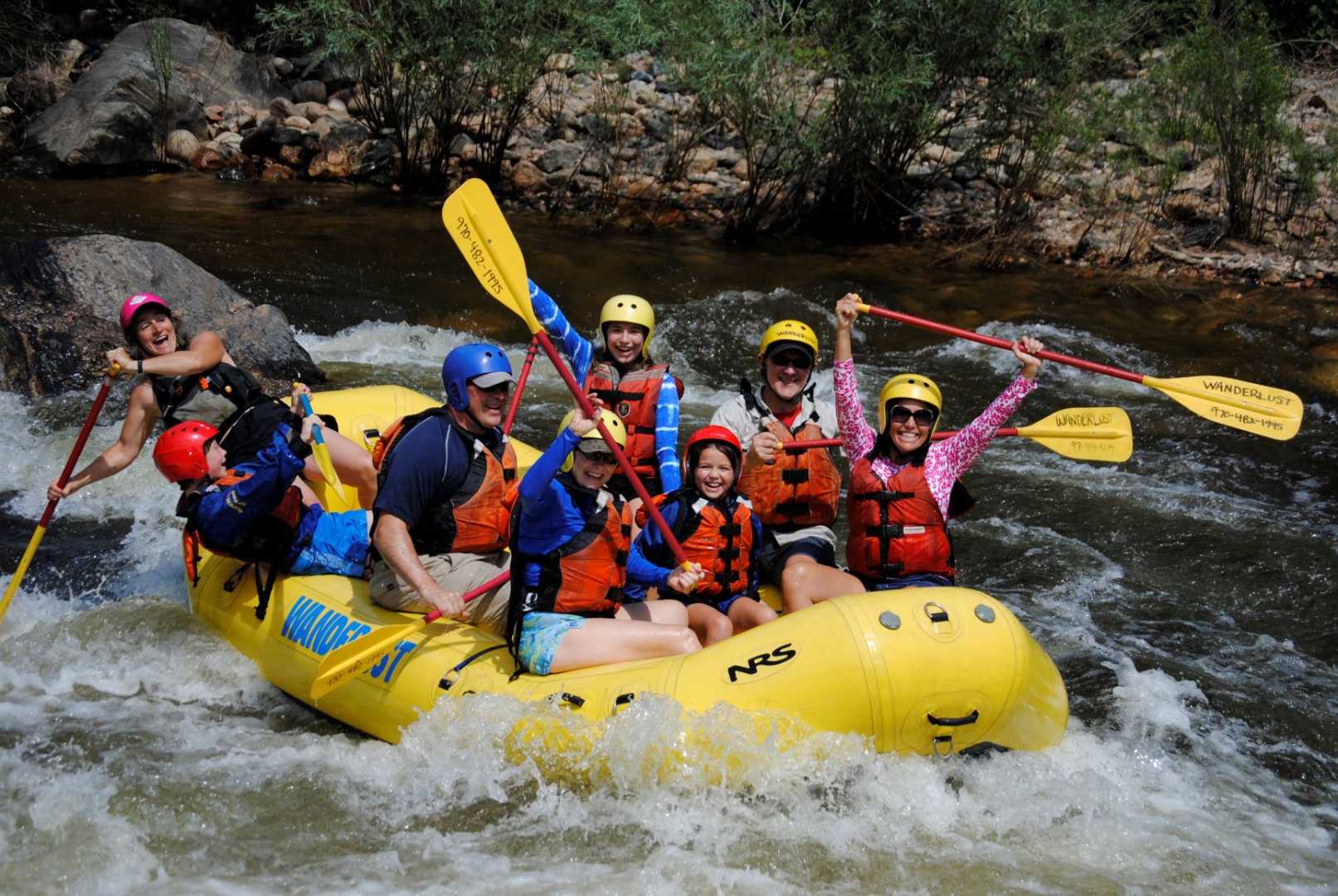
Our group was small — five of us total — most of us strangers. One guy wore brand-new water shoes and a GoPro strapped to his helmet. The rest of us just gave each other quiet nods and half-smiles, all feeling the same mix of nerves and excitement.
The guide gave us a quick once-over and smirked like he had seen this exact group a hundred times before. He walked us through the safety rundown with the kind of calm that comes from experience.
“If you fall in, don’t fight the river,” he said. “Feet up, head up, swim hard toward the raft. Smile for the camera if you can.”
We suited up in wetsuits and helmets, carried the raft down a gravel path, and stepped into the shallows. The water was cold, fast, and waiting.
Then we pushed off. The current took hold instantly, pulling us into the first bend as the shoreline slipped away behind us.
Instant Wake-Up Call
The first rapid hit like a slap across the face. One second we were floating through calm current, barely getting our bearings, and the next we were swallowed by chaos. Cold mountain water crashed over the bow and soaked us to the bone in an instant. The raft dropped hard into a trough, then snapped upward like it had a mind of its own. I barely had time to lock my feet under the cross tube before we were spinning sideways, slammed by a curling wave that knocked half the air out of my chest.
The rapid didn’t care that we were still getting our rhythm. It kept coming at us — drops, holes, lateral waves — all stacked one after another. The raft jolted, twisted, and groaned as we hit each feature. Our paddles slapped wildly against the current, sometimes landing clean, sometimes striking nothing but air. We were completely in it, soaked and shouting, a chaotic mess of movement and noise.
We screamed from shock, laughed from pure adrenaline, and swore without thinking. Every one of us was wide-eyed and locked in. We paddled like our lives depended on it. Which, in that moment, they kind of did.
The Real Ride Begins: Class IV Mayhem
The Poudre is no joke. This is not one of those rivers where you can sit back, dip your paddle in occasionally, and enjoy the scenery. This river keeps you engaged from the first push off until you drag the raft out at the end. It is narrow in spots, with sharp corners that sneak up fast and boulders scattered like obstacles in a pinball machine. The lines are tight, the current is pushy, and even a half-second of hesitation can put you off course.
There is no drifting. There is no coasting. Every second on the water demands focus. You are constantly reacting to what the river is throwing at you, and it rarely throws the same thing twice. One moment you’re paddling through a calm patch with just enough time to breathe, and the next you’re nose-first into a crashing wave, bracing against a surge that tries to rip the paddle from your hands.
We bounced through wave trains that slammed the floor of the raft like a drum. Holes opened up in front of us without warning, swallowing the nose of the boat and then spitting it back out. Every twist in the canyon revealed something new and wild. Side channels. Boils. Jagged rocks that seemed to reach out at you like fingers.
There were a few times when the raft launched off a standing wave, just enough to lift us out of our seats. I felt the rubber flex under my feet and caught air before crashing down again, barely managing to keep my paddle out of someone else’s face. It was chaos, but it was controlled chaos. Our movements were clumsy but determined. The raft heaved and bucked like it wanted to throw us out, and we fought to stay in.
Our guide shouted commands over the roar of the water. Forward. Harder. Stop. Left side. Hold on. His voice was clear but urgent, like he was trying to direct a team of rookies through a battlefield. We moved in rhythm when we could, fell apart when it got rough, and pulled ourselves back together before the next hit.
And somehow, through all of it, we kept going. We blasted through narrow chutes that looked too small to fit through. We got spun, drenched, nearly flipped, and tossed around like we were made of nothing. But we held on. We paddled like we meant it. And every time we popped out the back side of a rapid, still upright and still inside the raft, it felt like a small miracle.
Lessons from the Poudre
One of the things I love about rafting is how it resets you. You can’t think about work emails or relationship problems or social media when you’re trying not to flip into a hole the size of a car. All you can do is breathe, move, and trust your crew.
Out there rafting on the Poudre, I forgot everything except the river.
I noticed the pine trees high above the canyon walls. I noticed the hawk circling overhead. I noticed the way the sunlight hit the spray just right, turning the chaos into a kind of beauty. And I noticed my teammates. Five people who, an hour earlier, didn’t know each other’s names, now grunting, paddling, laughing, and swearing like we’d trained together for years.
Rafting has a way of bonding people. You’re either going to make it together, or you’re going to swim together. Either way, it’s shared glory.
The Takeout
We ended the trip at a wide, calm bend in the river where the current finally seemed to exhale. The roar of the whitewater faded behind us, replaced by the gentle rustle of wind through the trees and the occasional clatter of loose paddles against the raft. Our arms were shot, shoulders burning, faces red from the sun and spray. No one said much at first. We just sat there, floating for a moment, letting it all sink in.
Once we reached the takeout point, we dragged the raft up onto the rocky bank, still wobbly from the hours of fighting the current. Lifting it onto the trailer felt like carrying a fallen comrade. Everyone was quiet, grinning, heads buzzing with the kind of calm that only comes after surviving something intense. We peeled off our soaked wetsuits and splash jackets, skin wrinkled and steaming in the late afternoon sun, stripping down like snakes shedding skins. Our legs were muddy, our knuckles scraped, and no one cared. It felt good just to stand on solid ground again.
Back at the outpost, the gear was tossed into bins, and the guides moved through their end-of-day routine like a band breaking down after a show. Someone cracked open a cooler, and cold beers started making their way around. No speeches. No ceremony. Just tired cheers, plastic cups raised in unison, and the clink of bottles against paddles laid across picnic tables. We toasted to the river. To the near misses. To the strangers who paddled like a team. To staying in the raft when it counted. To going overboard and coming back with a laugh.
Later that evening in Estes Park, I found myself at a small bar tucked along a quiet stretch of the main road. The sun was setting behind the peaks, casting long shadows across the rooftops and turning the mountains the color of rust and flame. I sat out on the deck with a burger in front of me, a cold drink in hand, and my whole body still humming from the day.
My shoulders ached, my fingers were raw, and I was still a little damp. My clothes smelled like riverwater and pine. My voice was hoarse from laughing and shouting over the rapids. I had sand in my shoes and a scrape on my elbow that stung every time I moved.
And I could not stop smiling.
Something about the day stuck with me. It was not just the adrenaline. It was the clarity. The simplicity. The way the river forced everything else out of my head. No notifications. No decisions to make. Just the next paddle stroke, the next hit, the next moment.
It reminded me that the best days aren’t always the smoothest. Sometimes they are the ones that knock you around a little, steal your breath, and leave you walking away a little bruised, a little sore, and completely alive.
Why the Poudre Was the Best
I’ve done bigger rapids. I’ve been on longer expeditions, the kind that stretch across days and leave you sleeping on riverbanks with sand in your ears. I’ve paddled through tropical heat, high-altitude oxygen debt, and even one river that smelled like diesel and cow dung. But somehow, the Poudre hit a different kind of sweet spot. It was not the biggest or the most remote, but it had this perfect mix of raw challenge, stunning scenery, and pure Colorado mountain grit.
The rapids were tight and fast, constantly changing. The technical lines kept my brain lit up from the first bend to the last. You could not zone out. You had to stay sharp, read the current, and respond fast. Every movement mattered. The river didn’t allow you to just float along. It demanded decisions and effort.
And then there was the cold. That bone-deep mountain water is not something you ever really get used to. It bites through wetsuits and gloves, wakes up every nerve ending in your body, and keeps you grounded in a way that nothing else does. You can’t drift into your head when your entire body is focused on just staying upright and warm.
The canyon itself felt like something out of a dream. Tall walls of rock, streaked with age and shadow, closed in around us. Pines clung to the cliffs like they were growing out of the stone. Hawks circled overhead. The whole place felt alive, like it was breathing with us. We weren’t just moving through the canyon. We were part of it.
It felt wild in a way that most things in our modern lives don’t. It wasn’t packaged or curated. There was no app to make it easier. It didn’t offer any guarantees. You earned every second.
And that’s the thing about the Poudre. You earn it. Every rapid, every hard pull of the paddle, every bump and bruise. It makes you work for the reward. It tests you. It humbles you. It gives you those moments of chaos where the raft nearly flips and you find yourself laughing because you are still in it, still paddling, still fighting.
That’s the reward. Not the photo or the story, but the feeling of surviving something that didn’t have to let you through. You get to the end, soaked and aching, and you know you didn’t coast. You know you showed up.
And if you’re anything like me, you leave the river already planning how to come back and do it all over again.
Tips for Fellow Junkies
When to Go:
Late May through early July, depending on snowmelt. Earlier means higher water and more intense runs. Later in the season, it mellows but is still a blast.
Who to Go With:
Do your research to find the best river guides with the most knowledge of the river and the rapids you’ll face. You don’t want to be out there with someone who doesn’t know what they’re doing.
What You’ll Need:
- A healthy fear of cold water
- Decent upper body strength
- Quick-drying clothes (avoid cotton)
- Sense of humor
- Respect for the river
Would I Do It Again?
In a heartbeat. In fact, I’ve already booked a return trip for next season. I want to hit it during peak runoff when the Poudre turns from wild to borderline unhinged.
Adventure doesn’t always have to be on another continent. Sometimes it’s just up the road, where the water is cold, the rocks are sharp, and the river has a story to tell.
So if you’ve ever felt that pull toward the wild, don’t wait. Get out to Colorado. Find the Poudre. Let it humble you. Let it teach you.
Let it carry you.
See you out there.